Notre-Dame Basilica vs Saint Joseph's Oratory: A Montreal Visitor's Comparison
How Montreal's two most important Catholic landmarks differ in architecture, atmosphere, location and visitor experience — and how to choose between them.
Montreal has two religious landmarks that international visitors regularly weigh against each other: Basilique Notre-Dame de Montreal in Old Montreal and Saint Joseph's Oratory of Mount Royal on the north slope of Mont-Royal. They are very different buildings serving very different purposes, and most visitors who can spend time at both leave glad they did. This guide compares them honestly on architecture, atmosphere, location, accessibility, ticketing and the kind of visitor each suits best — so you can decide which fits your trip if you only have time for one, or how to sequence both if you have a full day to spend on Montreal's religious heritage.
Two Buildings, Two Centuries, Two Styles
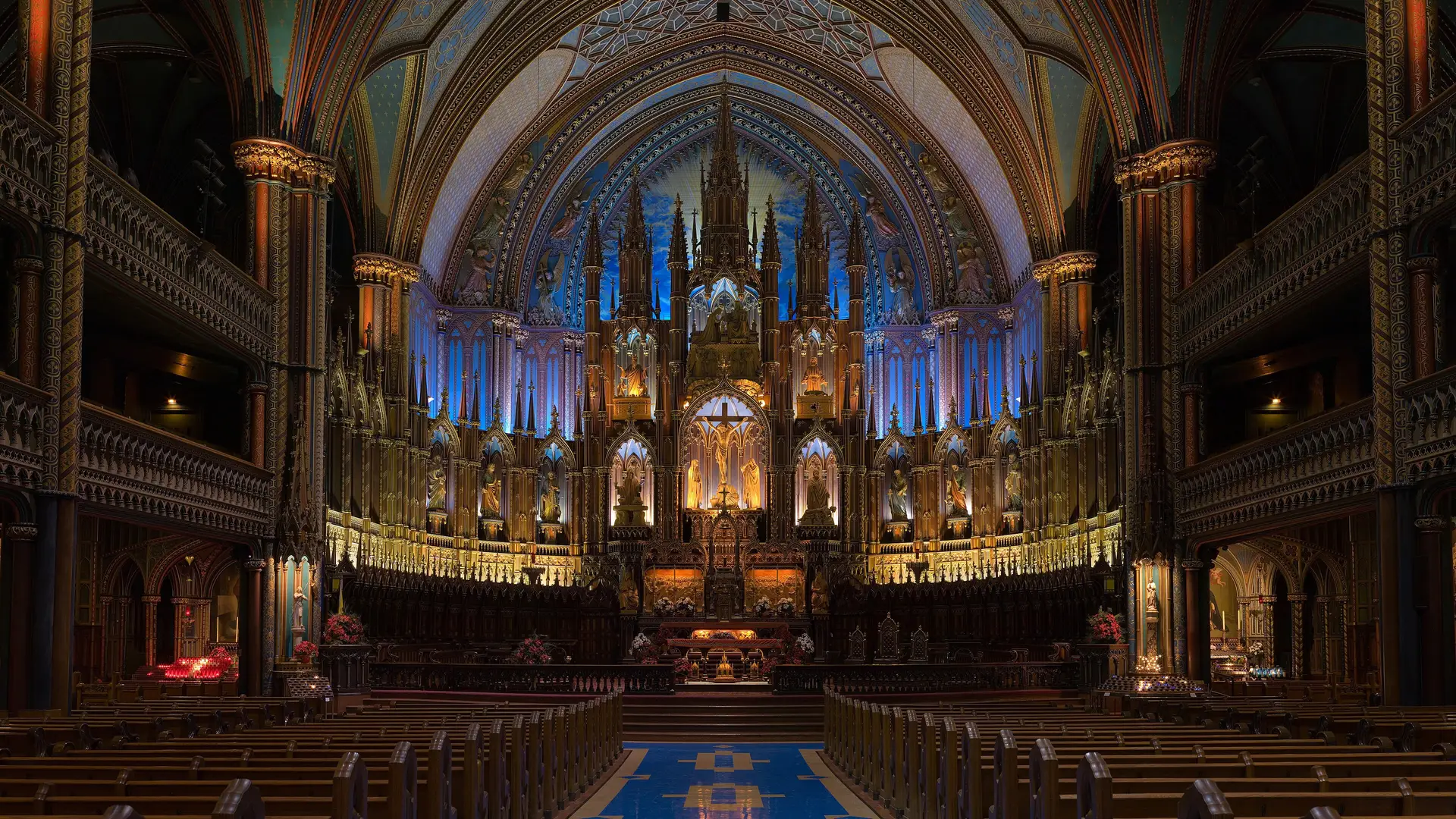
Notre-Dame Basilica is the older and more compact of the two: a Gothic Revival parish church built between 1824 and 1829 to a design by Irish-American architect James O'Donnell. Its interior — redesigned between 1872 and 1879 by Quebec architect Victor Bourgeau — is the most elaborate in North America, with a royal-blue vaulted ceiling studded with gold-leaf stars, a carved-walnut sanctuary, polychromatic side chapels, and a 7,000-pipe Casavant Freres organ from 1891. It was designed to seat up to 10,000 worshippers and was once the largest church on the continent.
Saint Joseph's Oratory is a 20th-century work on a completely different scale. Construction of the basilica began in 1914 and continued in phases for decades, with architects including Dalbe Viau, Alphonse Venne, Dom Paul Bellot and Gerard Notebaert contributing across the project. It is a vast Italian Renaissance-style basilica capped by a copper-clad dome that is one of the largest of its kind in the world. Its interior is restrained and contemplative rather than ornate, dominated by the volume of the dome, the long Latin-cross nave, and natural light. Where Notre-Dame is intricate, Oratory is monumental.
Atmosphere and What Each Visit Feels Like
Notre-Dame is a paid sightseeing visit inside an active parish, organised around a self-guided route through the nave, the side chapels and the Sacred Heart Chapel behind the sanctuary. There are bilingual interpretation panels, a steady but managed flow of visitors, and an evening multimedia identity through AURA that has no parallel at Oratory. The visit feels like a curated museum experience inside a working church.
Saint Joseph's Oratory is primarily a pilgrimage site — the shrine of Saint Andre of Montreal (Brother Andre Bessette, canonised in 2010) and one of the most visited Catholic pilgrimage sites in the Americas. The atmosphere is quieter and more devotional. Pilgrims traditionally climb the centre wooden steps on their knees in prayer, the votive chapel holds thousands of candles, and the crypt church hosts daily masses. There is no AURA-style multimedia programme. The visit feels like a working shrine that happens to be architecturally extraordinary.
Location, Access and How Long It Takes
Notre-Dame is in Old Montreal at 110 Rue Notre-Dame Ouest, two minutes from Place-d'Armes metro and within walking distance of most downtown hotels, the Old Port cruise terminals, and the Pointe-a-Calliere museum. A daytime visit takes 45 to 60 minutes; AURA runs roughly 45 minutes plus a 30-minute doors-open window. Combined with one or two other Old Montreal stops, it fits cleanly into a half-day.
Saint Joseph's Oratory is on the north slope of Mount Royal at 3800 Queen Mary Road, approximately 8 kilometres northwest of Old Montreal. Cote-des-Neiges metro on the Blue Line is the closest station, roughly 15 minutes' walk from the Oratory entrance and the climb up to the basilica. By car or taxi from downtown the journey is 15 to 25 minutes depending on traffic. A typical visit — crypt church, basilica, votive chapel, museum and the views from the terrace — takes 90 minutes to two hours. The site is on a steep hill; an internal escalator and elevator system connects most levels for visitors who do not climb the steps.
Tickets, Cost and Booking
Notre-Dame Basilica is a ticketed attraction with three concierge-bookable products: the daytime self-guided visit, the AURA evening multimedia show, and a combined daytime-plus-AURA ticket at a bundle discount. Children five and under enter free; age tiers apply (adult, senior 65+, student 17-22, child 6-16). Timed entry applies and we recommend pre-booking AURA, which sells out one to two weeks ahead on peak summer Friday and Saturday evenings.
Saint Joseph's Oratory has no general admission charge — visiting the basilica, the crypt church, the votive chapel and the grounds is free. Donations are gratefully accepted at the shrine. The Oratory's museum, audio tours and special exhibitions may carry separate fees, and the site sometimes hosts ticketed organ recitals, choir performances and seasonal programmes. The Oratory does not have an evening multimedia show equivalent to AURA. We do not concierge-book Oratory visits — there is nothing to book.
Which Should You Choose If You Only Have Time for One?
If your time in Montreal is short and you have already committed to Old Montreal as part of your itinerary, Notre-Dame Basilica is the more efficient choice — it sits inside the historic quarter you were going to walk anyway, and AURA gives you a memorable evening anchor that does not exist anywhere else. If your trip leans toward Mount Royal, the Plateau, or the north side of the city, or if a contemplative pilgrimage site appeals more than a sightseeing visit, Saint Joseph's Oratory is the more rewarding day.
For visitors with a full day to give Montreal's religious heritage, the natural sequence is Oratory in the morning (climb the steps before the day warms up, see the basilica when it is quiet, allow two hours on site), lunch in Cote-des-Neiges or back downtown, afternoon free, then Notre-Dame Basilica for an evening AURA performance. The two sites are stylistically and theologically complementary — one a 19th-century parish-church flagship of Catholic Quebec, the other a 20th-century devotional shrine — and the contrast is part of the value of seeing both.
Frequently asked
Is Saint Joseph's Oratory free to visit?
Yes. General admission to the basilica, crypt church, votive chapel and grounds is free. The museum and some special programmes carry separate fees, and donations are welcomed at the shrine.
Which is bigger, Notre-Dame Basilica or Saint Joseph's Oratory?
Saint Joseph's Oratory is much larger by overall scale, with one of the world's largest church domes. Notre-Dame Basilica is more compact but vastly more elaborate inside.
Does Saint Joseph's Oratory have a show like AURA?
No. The Oratory is a working shrine without a multimedia evening programme. It does host organ recitals, choir performances and seasonal ticketed events.
Can I visit both in one day?
Yes. Oratory in the morning (two hours including the climb and museum), lunch, then Notre-Dame Basilica in the late afternoon or for an evening AURA show is a comfortable full-day pattern.
Is Saint Joseph's Oratory wheelchair accessible?
Yes — the Oratory operates an internal escalator and elevator system that reaches the major levels for visitors who do not use the steps. Specific access details are published on the Oratory's official website.
Which has the better organ?
Both are major organs by world standards. Notre-Dame's 1891 Casavant Freres has 7,000 pipes and 92 stops. The Oratory's Rudolf von Beckerath organ, installed in 1960, is considered one of the finest mechanical-action concert organs in North America.
Are masses open to tourists at both?
Yes at both, but they are religious services rather than tourist visits. Notre-Dame's daily masses are in French only; the Oratory celebrates in French and English. Photography during mass is not permitted at either.
Is Notre-Dame's daytime ticket expensive compared to free entry at Oratory?
The two sites have different operating models — Notre-Dame charges admission to fund conservation of one of the most elaborate church interiors in North America, while the Oratory relies on donations and shrine offerings. We don't recommend choosing on cost alone.