What to See Inside Notre-Dame Basilica of Montreal
A guided walk through the Bourgeau sanctuary, the 7,000-pipe Casavant Freres organ, the Sacred Heart Chapel and the polychromatic interior that made Notre-Dame the most elaborate church in North America.
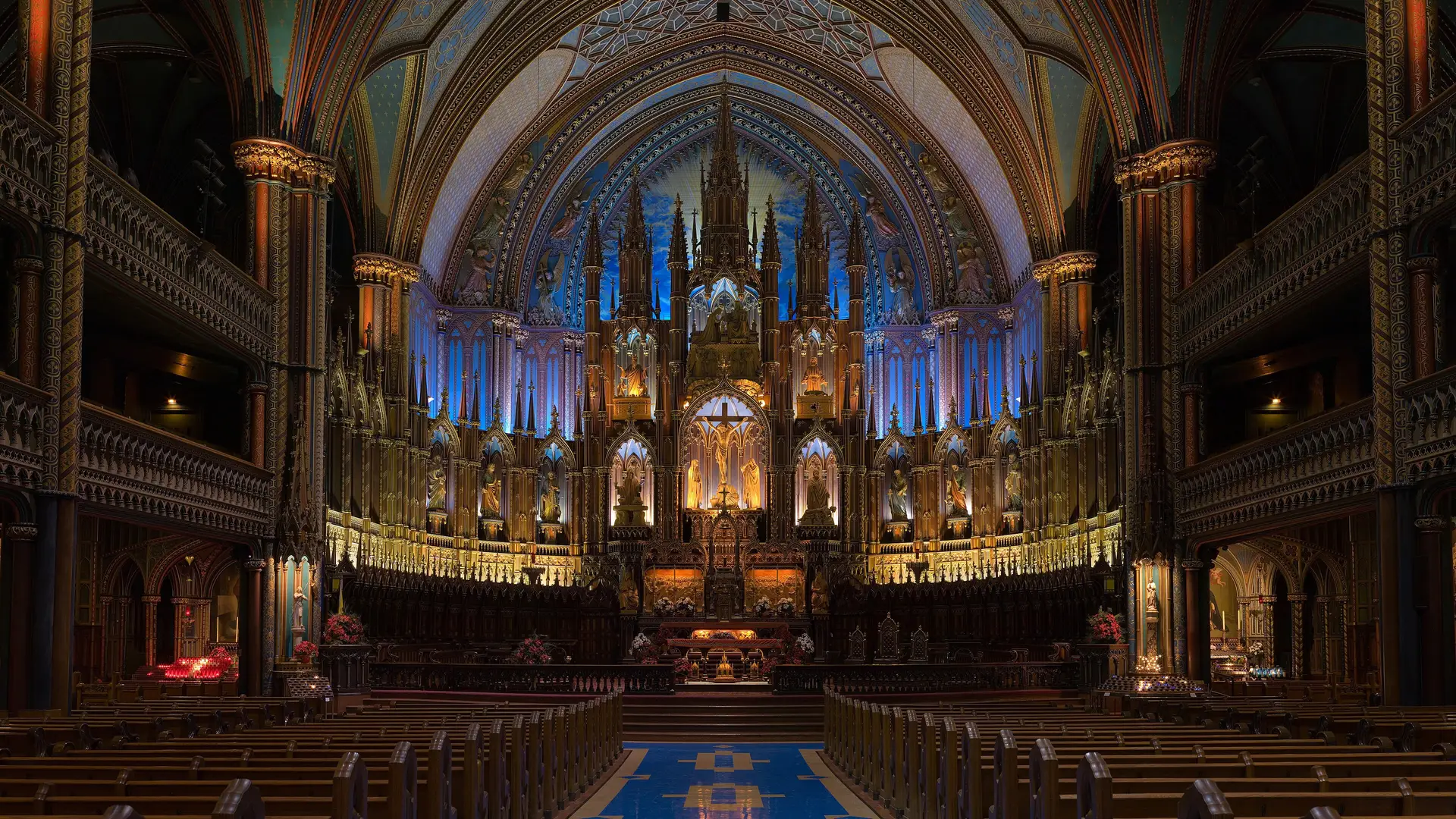
Walking into Notre-Dame Basilica for the first time is one of the great architectural moments in North America. The eye goes everywhere at once — the deep-blue vaulted ceiling overhead, the gold-leaf stars catching the lights, the carved-walnut sanctuary at the far end, the rose windows above the gallery, the polychromatic chapels along the side aisles, and the 7,000 pipes of the Casavant Freres organ in the rear loft. Most visitors who take the self-guided daytime visit spend 45 to 60 minutes inside reading the bilingual interpretation panels; visitors who linger over the details routinely spend 90 minutes or more. This guide walks you through what to look for, in roughly the order a typical visit follows.
The Bourgeau Sanctuary
The carved-walnut sanctuary at the front of the basilica is the masterpiece of Quebec architect Victor Bourgeau, completed as part of the 1872 to 1879 redecoration. It is carved entirely from Quebec walnut, finished with painted polychromatic panels and gold leaf, and structured as a three-tier composition: the altar and tabernacle at the base, a middle register of carved scenes from the life of the Virgin, and an upper tier rising toward the apex of the choir. The altar itself is a working liturgical altar — daily mass is celebrated here in French, and the sanctuary is the setting for weddings and state funerals.
Two details worth studying up close: the carving of the central tabernacle door visible from the front pews during open hours, and the painted polychromy on the side panels. The sanctuary lighting is intentionally warm; the gold leaf catches the morning light through the rose windows and the late-afternoon light from the west aisle in completely different ways. A second visit at a different time of day shows the sanctuary in a different palette.
The 1891 Casavant Freres Organ
The basilica's great organ was built in 1891 by Casavant Freres, the Saint-Hyacinthe firm that became one of the world's leading organ-builders and continues to build organs across North America today. The Notre-Dame instrument has 7,000 pipes, 92 stops, four manual keyboards and a pedalboard, and is historically significant as the first organ ever built with electrically operated adjustable-combination pedals — a technological breakthrough in 1891 that became a worldwide standard.
The organ is housed in the rear loft above the main entrance, framed by carved wooden casework that matches the Bourgeau sanctuary palette. From inside the nave you cannot see the full pipework — only the visible facade pipes — and the loft is not part of the public self-guided route. The instrument is in regular use for Sunday mass, concerts and the Handel's Messiah season; visitors who time their daytime visit around a rehearsal or recital will sometimes hear the organ in use. The basilica publishes its concert calendar on the events page of its official site.
The Sacred Heart Chapel (Chapelle du Sacre-Coeur)
Behind the main sanctuary, reachable through a doorway on the right side of the choir, is the Sacred Heart Chapel — known locally as the Chapelle du Sacre-Coeur and informally as the wedding chapel because so many high-profile Quebec weddings have been celebrated here. The original Sacred Heart Chapel was added behind the basilica between 1888 and 1891 but was destroyed in a 1978 fire. The chapel was rebuilt and reconsecrated in 1982 with a modern reinterpretation: the lower walls and arches are restored to the 19th-century neo-Gothic original, while the upper level is a 1982 bronze sculpture and altarpiece by Quebec artist Charles Daudelin.
The Daudelin altarpiece — a massive bronze relief depicting the journey of humanity toward the divine — is one of the most distinctive contemporary works in any major Canadian church. The contrast with the 19th-century walnut Bourgeau sanctuary on the other side of the wall is intentional and effective. The chapel continues to host weddings on a private booking basis through the parish.
The Side Chapels, Stations of the Cross and Rose Windows
The side aisles on the north and south walls of the nave hold a series of polychromatic side chapels, each dedicated to a different saint and each with its own altarpiece and 19th-century painted decoration. The chapels are bilingually interpreted with panels that explain the iconography, the saint's role in Quebec Catholic history, and the artistic details to look for. The 14 Stations of the Cross — carved wooden reliefs set into the side walls — were added during the Bourgeau redecoration and depict the traditional Catholic devotional sequence from Jesus's condemnation to his entombment.
Above the gallery on both sides of the nave, the rose windows let in natural light that animates the interior throughout the day. The light through these windows is the single biggest variable in the daytime visit — early morning gives a soft east-side glow on the sanctuary, midday gives full vault illumination, and the late-afternoon light on the west side warms the carved-walnut detail. The basilica's interpretation panels point out which artists, glaziers and craftsmen contributed to each named feature; many of the names — Bourgeau, O'Donnell, Casavant — recur across the building because Notre-Dame was built and decorated by a small constellation of Quebec studios over five decades.
Frequently asked
How long does the self-guided visit take?
Typically 45 to 60 minutes for a full read of the bilingual interpretation panels. Visitors who linger over the chapels and the sanctuary regularly spend 90 minutes or more.
Can I see the Casavant organ up close?
The organ loft is not part of the public visit. You can see the facade pipes from the nave during open hours, but the loft itself is restricted.
Is the Sacred Heart Chapel always open to visitors?
The chapel is open during normal daytime visiting hours but may be closed for private weddings, which are scheduled through the parish. Check at the entrance on arrival.
Is the blue ceiling original to the 1820s building?
No. The blue-and-gold ceiling was added during the Victor Bourgeau redecoration between 1872 and 1879. The 1829 interior was significantly more austere.
Where is the wedding chapel?
The Sacred Heart Chapel (Chapelle du Sacre-Coeur), behind the main sanctuary, has hosted many notable Quebec weddings since its 1982 reconsecration.
Can I take photographs inside?
Yes during the daytime self-guided visit, without flash or tripods. Photography is restricted during mass and during the seated portion of the AURA show.
Are the interpretation panels in English?
Yes. The interpretation panels along the self-guided route are bilingual French and English.
What is the best spot for the classic blue-ceiling photograph?
Stand in the central aisle about a third of the way back from the sanctuary, point the camera up and slightly toward the apex, and use a wider focal length. Early morning light gives the most saturated blue.
Is there an audio guide for the daytime visit?
The interpretation panels are the primary self-guided resource. Audio guides and guided tours are available separately on a published schedule by the Fabrique; we can advise on availability when you book.