AURA at Notre-Dame Basilica Montreal: The Immersive Experience Explained
What AURA actually is, how the 45-minute show is structured, who Moment Factory are, and what to expect from start to finish at Basilique Notre-Dame de Montreal.
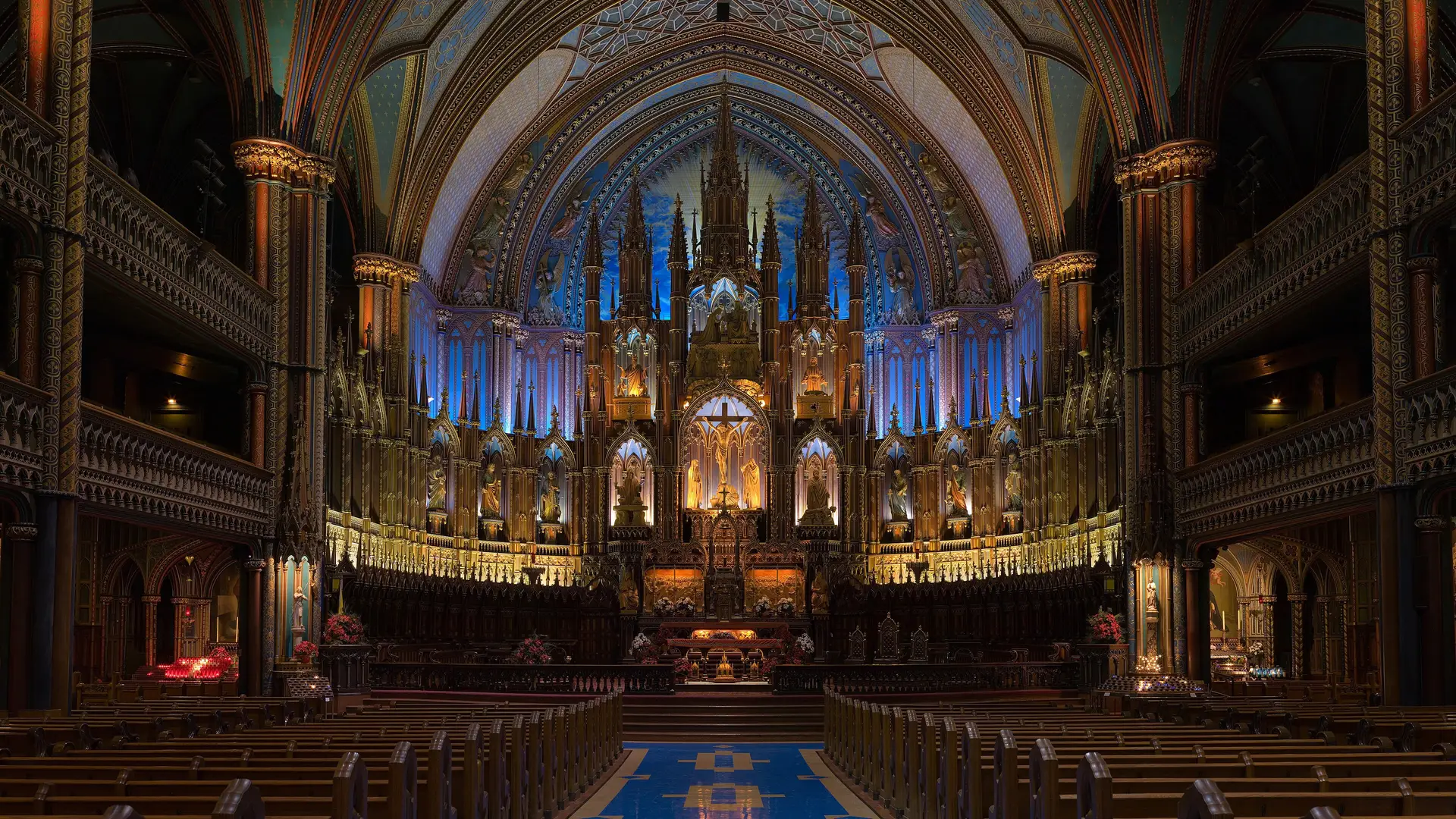
AURA is the headline evening programme at Basilique Notre-Dame de Montreal — a 45-minute immersive multimedia experience produced by Moment Factory, the Montreal-based studio whose other work includes the permanent installation at the Sagrada Familia in Barcelona, the Sphere in Las Vegas and the Rain Vortex at Singapore's Changi Airport. AURA is not a film, not a concert, and not a religious service; it is a purpose-built projection-mapped experience that uses the basilica's vaulted ceiling, walnut sanctuary and side chapels as a single seamless canvas. For most international visitors AURA is the single most memorable evening of their Montreal trip. This guide explains what it actually is, how the show is structured, and what to expect from arrival to exit.
Who Made AURA and Why It Exists
AURA was created by Moment Factory, a Montreal multimedia studio founded in 2001 that specialises in permanent immersive installations in major cultural venues worldwide. Their portfolio includes the official multimedia experience at the Sagrada Familia in Barcelona, projection elements at the Las Vegas Sphere, the Rain Vortex sound-and-light installation at Singapore's Changi Airport, and night-walk installations in national parks across Canada and Europe. AURA opened at Notre-Dame Basilica in 2017 and runs as a permanent evening programme licensed by the Fabrique de la paroisse Notre-Dame de Montreal.
The basilica's relationship with AURA is a licensing one rather than a creative one — the Fabrique authorises Moment Factory to use the building as a canvas, and the religious imagery, music and narrative arc are designed by Moment Factory's team to be respectful of the active parish context. AURA is not a religious service. It is a secular cultural experience inside a sacred building, scheduled outside the basilica's daytime visit and Sunday mass hours to keep the two functions distinct.
How the 45-Minute Show Is Structured
AURA is split into two distinct phases. You arrive at the basilica 30 minutes before the published start time — doors open then and ushers seat early arrivals — and the experience begins with a 15- to 20-minute self-paced walk through 'illuminated stations' along the side aisles and rear of the nave. Each station highlights a single sculpture, altarpiece or architectural feature with orchestrated lighting and ambient sound, designed so that you discover the basilica's details one at a time before the main event. You move at your own pace; some visitors do all the stations, others sit down early.
The 25-minute seated main show then runs in three acts, named by the basilica as 'The Birth of Light,' 'The Obstacles' and 'The Open Sky.' During the main show the vaulted ceiling, the carved-walnut sanctuary, the side chapels and the rose windows all become a single seamless projection canvas; an orchestral score plays through the sanctuary's sound system; the gold-leaf stars on the blue ceiling appear to ripple and travel overhead. The seating is in the basilica's normal pews. The show ends with applause-permitting cues; ushers then release the audience back into Old Montreal.
What to Expect — Atmosphere, Pace and Sensory Intensity
The basilica is darkened during AURA — much darker than during a daytime visit — and the projection content is high-contrast with rapid colour and brightness shifts during certain passages. The operator notes formally that AURA includes 'loud music, rapid flashing lights, and lasers' that 'may not be appreciated by certain people or young children sensitive to these effects.' Visitors with photosensitive epilepsy or sensory-processing sensitivity should weigh this carefully. The volume of the orchestral score is high but not painful; the show is mixed for emotional weight rather than club-level loudness.
Pace-wise, AURA rewards arrival on time. The illuminated-stations phase begins immediately when doors open and continues until the main show starts; late arrivals miss the slowest, most contemplative part of the experience. The main show itself is fast-paced and immersive in a way that benefits from being seated calmly with phone away. Most visitors describe it as emotionally powerful regardless of religious background — Moment Factory's narrative arc is about light, struggle and hope rather than denominational theology.
Photography, Phones and Etiquette
Photography rules during AURA are split deliberately. Photos and videos are permitted during the first 15- to 20-minute walking phase through the illuminated stations — and this is genuinely the best time to capture the basilica's architectural detail under projection lighting. During the 25-minute seated main show, photography and video are not permitted. This is both a copyright matter (Moment Factory's projection content is licensed) and an audience-experience choice — phone screens in a darkened basilica spoil the immersion for everyone seated nearby. Ushers will quietly ask visitors using phones during the seated show to put them away.
Broader etiquette: this is still an active parish church, not a theatre. The basilica asks that visitors dress respectfully (the daytime dress-code recommendation applies — covered shoulders, no beachwear), enter quietly, and remain seated through the main show. Talking during the seated phase is discouraged. Children under 5 are admitted free but the operator notes the show may not suit very young or noise-sensitive children. Professional media access (photography for publication, filming for broadcast) is handled separately by the basilica's Media and Press department on application; this is not arranged through concierge bookings.
Combining AURA with the Daytime Visit
AURA and the daytime self-guided visit are genuinely different experiences. The daytime visit is about architecture, history and natural light — the Bourgeau sanctuary studied up close, the rose windows animating the nave, the bilingual interpretation panels read at your own pace. AURA is the same basilica reimagined as a multimedia stage with the natural lights off and Moment Factory's projection content on. Visitors who do both — typically a 45- to 60-minute morning daytime visit followed by an evening AURA show — almost always say it was the right call. The building reads completely differently under the two lighting regimes.
The basilica offers a combined daytime-plus-AURA ticket that bundles both products at a discount versus the separate prices. If you book through us, the combined ticket is one of our concierge-bookable products alongside the standalone daytime visit, the standalone AURA show and a small-group guided tour add-on. We confirm both timed slots before purchase and deliver them together in a single booking email, so you have one reference to show at the door for both visits.
Frequently asked
How long is the AURA show?
Approximately 45 minutes total: a 15- to 20-minute walking phase through illuminated stations, followed by a 25-minute seated main show in three acts.
What time should I arrive for AURA?
Doors open 30 minutes before the published start time. Arriving when doors open lets you do the full illuminated-stations phase before the seated show begins.
Is AURA the same show every night?
Yes. AURA is a permanent Moment Factory installation with identical staging, projection content and music every performance year-round.
Can I take photos during AURA?
Photos and videos are permitted during the first walking phase but not during the 25-minute seated main show, for copyright and audience-experience reasons.
Is AURA suitable for children?
Children five and under enter free. The operator notes that loud music, rapid flashing lights and lasers 'may not be appreciated by certain people or young children sensitive to these effects.' Use judgement for younger or noise-sensitive children.
Is AURA a religious experience?
No. AURA is a secular cultural experience produced by Moment Factory under licence from the basilica. It is held outside the basilica's mass and daytime-visit hours.
What language is AURA in?
AURA is largely non-verbal — driven by orchestral music, projection imagery and ambient sound rather than spoken narration — and works equally well for visitors who speak no French.
Is the seating reserved?
Seating is in the basilica's normal pews on a general-admission basis. Doors open 30 minutes early; arriving early gives the best choice of seating in the central nave.
Can I do AURA and the daytime visit on the same day?
Yes — this is the most common pattern for international visitors. The basilica sells a combined ticket at a bundle discount, which we offer as a concierge-bookable product alongside the standalone options.
Does AURA run on Sundays?
Per the published Fabrique schedule, AURA typically runs Tuesday to Saturday with no Sunday performances. We confirm the schedule for your specific date when you book.